THE PRINCIPLE OF NON REFOULEMENT AND THE INTER-AMERICAN COURT OF HUMAN RIGHTS
DOI:
https://doi.org/10.22295/grifos.v35i63.8447Keywords:
Migration, Human Rights, Migration Control, Refuge, State SovereigntyAbstract
This article analyzes the case Pacheco Tineo Family v. Plurinational State of Bolivia, aiming to examine state conduct in light of international norms on the protection of migrants and refugees. The central research problem is guided by the following questions: (i) what were the main legal grounds of the claim brought against the Bolivian State? and (ii) to what extent do the adopted conducts reveal migration control practices incompatible with international conventions? The theoretical-conceptual approach is based on the dialogue between international human rights protection and state sovereignty, with emphasis on the principle of non-refoulement. Methodologically, it is a qualitative and bibliographic research, supported by a systematic analysis of academic literature, official documents, jurisprudence of the Inter-American Court of Human Rights, and other specialized sources. The results show that the Bolivian State violated procedural guarantees, the principle of non-refoulement, and fundamental rights of migrants and children, resulting in condemnation by the Inter-American Court. It is concluded that international norms on migration and refuge were simultaneously structured as instruments for both rights protection and state sovereignty preservation, which weakens their effectiveness and allows practices that, in many cases, operate to the detriment of migrants.
Downloads
References
ALEINIKOFF, T. Alexander. State-centered refugee law: From resettlement to containment. Michigan Journal of International Law, v. 14, p. 120–120, 1992.
BEHRMAN, Simon. Refugee law as a means of control. Journal of Refugee Studies, v. 32, n. 1, p. 42–62, 2019.
BENTO, Maria Waldiléia do Espírito Santo; SILVA, David Junior de Souza. EU LÁ, EU CÁ: um estudo sobre a diáspora warao a partir do olhar da criança sobre o processo de migração para a cidade de belém/pa. Revista Grifos, [S.L.], v. 32, n. 59, p. 01-22, 21 out. 2022. Revista Grifos. http://dx.doi.org/10.22295/grifos.v32i59.6688.
BLOOM, Tendayi. The business of migration control: Delegating migration control functions to private actors. Global Policy, v. 6, n. 2, p. 151–157, 2015.
BRASIL. Decreto nº 50.215, de 28 de janeiro de 1961. Promulga a Convenção relativa ao Estatuto dos Refugiados, concluída em Genebra, em 28 de julho de 1951. Diário Oficial da União, Brasília, DF, 30 jan. 1961. Seção 1, p. 838. Disponível em: https://www2.camara.leg.br/legin/fed/decret/1960-1969/decreto-50215-28-janeiro-1961-389887-publicacaooriginal-1-pe.html. Acesso em: 15 abr. 2025.
CIDH. Corte Interamericana de Direitos Humanos. Caso Família Pacheco Tineo v. Estado Plurinacional da Bolívia. Disponível em: https://www.corteidh.or.cr/docs/casos/articulos/seriec_272_ing.pdf. Acesso em: 20 abr. 2025.
CONVENÇÃO RELATIVA AO ESTATUTO DOS REFUGIADOS. Genebra, 1951.
FITZGERALD, David Scott. Remote control of migration: theorising territoriality, shared coercion, and deterrence. Journal of Ethnic and Migration Studies, v. 46, n. 1, p. 4–22, 2020.
GIL-BAZO, María-Teresa. The practice of Mediterranean States in the context of the European Union’s Justice and Home Affairs External Dimension: the Safe Third Country Concept Revisited. International Journal of Refugee Law, v. 18, n. 3-4, p. 571–600, 2008.
GOODWIN-GILL, Guy S.; McADAM, Jane. The Refugee in International Law. 3rd ed. Oxford: Oxford University Press, 2007.
MARTIN, Lauren. Refugees face higher burden of proof than criminals. UNSW Sydney, 2019. Disponível em: https://newsroom.unsw.edu.au/news/social-affairs/refugees-face-higher-burden-proof-criminals. Acesso em: 20 abr. 2025.
McAULIFFE, M.; OUCHO, L.A. (org.). World Migration Report 2024. Geneva: International Organization for Migration (IOM), 2024.
SELEE, Andrew et al. In a dramatic shift, the Americas have become a leading migration destination. Washington, DC: Migration Policy Institute, 2023.
UNHCR. Note on the Principle of Non-Refoulement. 1977. Disponível em: https://www.unhcr.org/publications/note-non-refoulement-submitted-high-commissioner. Acesso em: 20 abr. 2025.
UNHCR. The Principle of Non-refoulement as a Norm of Customary International Law. Geneva: UNHCR, 1994.
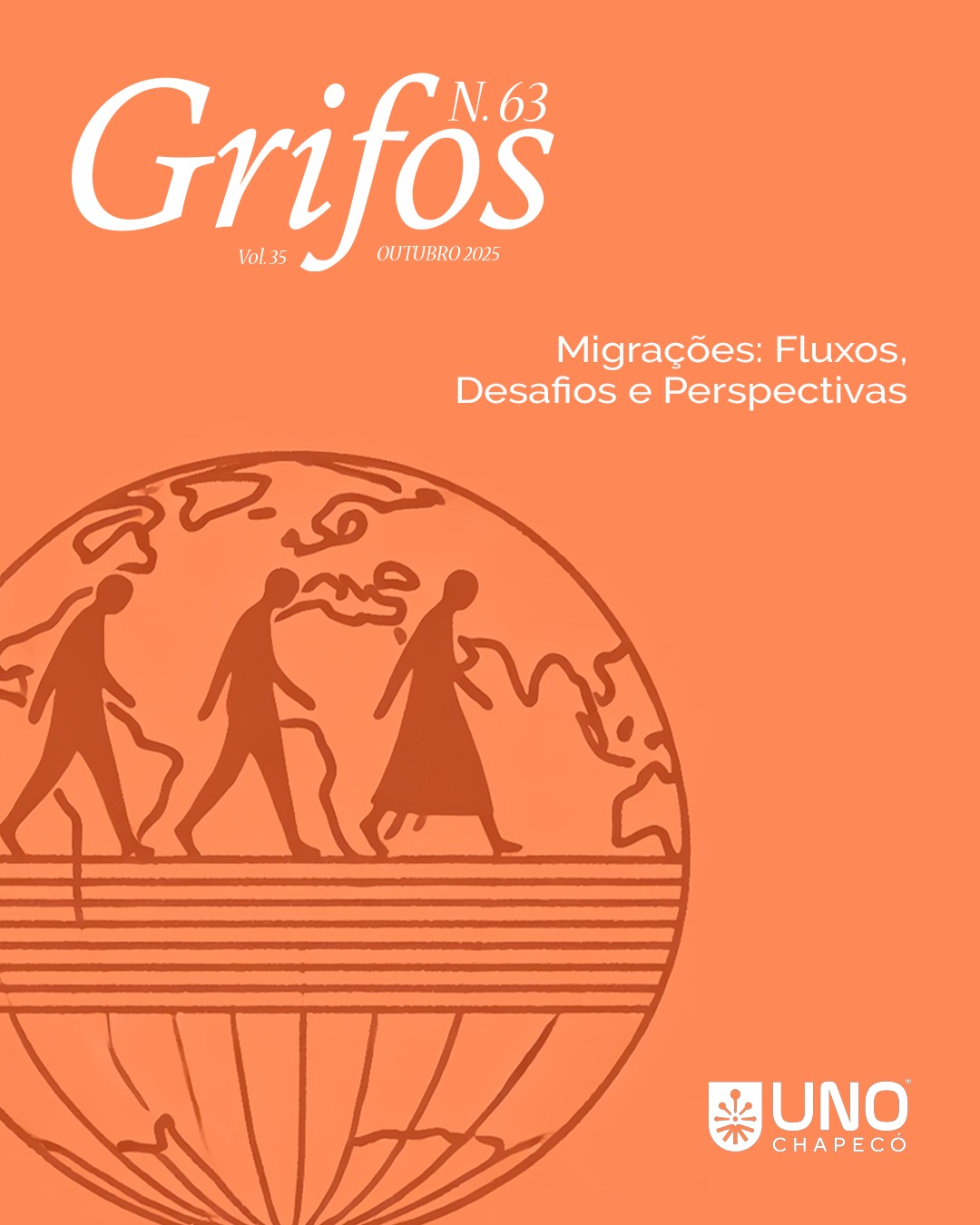
Downloads
Published
How to Cite
Issue
Section
License
Copyright (c) 2025 Revista Grifos

This work is licensed under a Creative Commons Attribution-NonCommercial-NoDerivatives 4.0 International License.
Estou ciente de que, em sendo aprovado, a publicação do artigo será no formato on-line no Portal de Periódicos da Unochapecó.
Também tenho ciência de que há autorização para assumir contratos adicionais separadamente, para distribuição não-exclusiva da versão do trabalho publicada nesta revista (ex.: publicar em repositório institucional ou como capítulo de livro), com reconhecimento de autoria e publicação inicial nesta revista.
Do ponto de vista do Creative Commons, a Revista Grifos é de acesso aberto e irrestrito, porém não permitindo adaptações nos artigos, nem o uso comercial.
Sobre a licença Creative Commons: As licenças e instrumentos de direito de autor e de direitos conexos da Creative Commons forjam um equilíbrio no seio do ambiente tradicional “todos os direitos reservados” criado pelas legislações de direito de autor e de direitos conexos. Os nossos instrumentos fornecem a todos, desde criadores individuais até grandes empresas, uma forma padronizada de atribuir autorizações de direito de autor e de direitos conexos aos seus trabalhos criativos. Em conjunto, estes instrumentos e os seus utilizadores formam um corpo vasto e em crescimento de bens comuns digitais, um repositório de conteúdos que podem ser copiados, distribuídos, editados, remixados e utilizados para criar outros trabalhos, sempre dentro dos limites da legislação de direito de autor e de direitos conexos.
A Revista Grifos adota o sistema: Atribuição-SemDerivações-SemDerivados CC BY-NC-ND: Permite o download dos seus trabalhos e o compartilhemento desde que atribuam crédito, mas sem que possam alterá-los de nenhuma forma ou utilizá-los para fins comerciais.
- Autores concedem à revista o direito de publicação, com o trabalho simultaneamente licenciado sob a Creative Commons Attribution-NonCommercial License que permite o compartilhamento do trabalho com reconhecimento da autoria do trabalho e publicação nesta revista.
- Autores têm autorização para assumir contratos adicionais separadamente, para distribuição não-exclusiva da versão do trabalho publicada nesta revista (ex.: publicar em repositório institucional ou como capítulo de livro), com reconhecimento de autoria e publicação inicial nesta revista.
- Autores têm permissão e são estimulados a publicar e distribuir seu trabalho online (ex.: em repositórios institucionais ou na sua página pessoal) com reconhecimento de autoria e publicação inicial nesta revista.
- A Política de Direito Autoral adotada está cadastrada no Diadorim <diadorim.ibict.br>.